

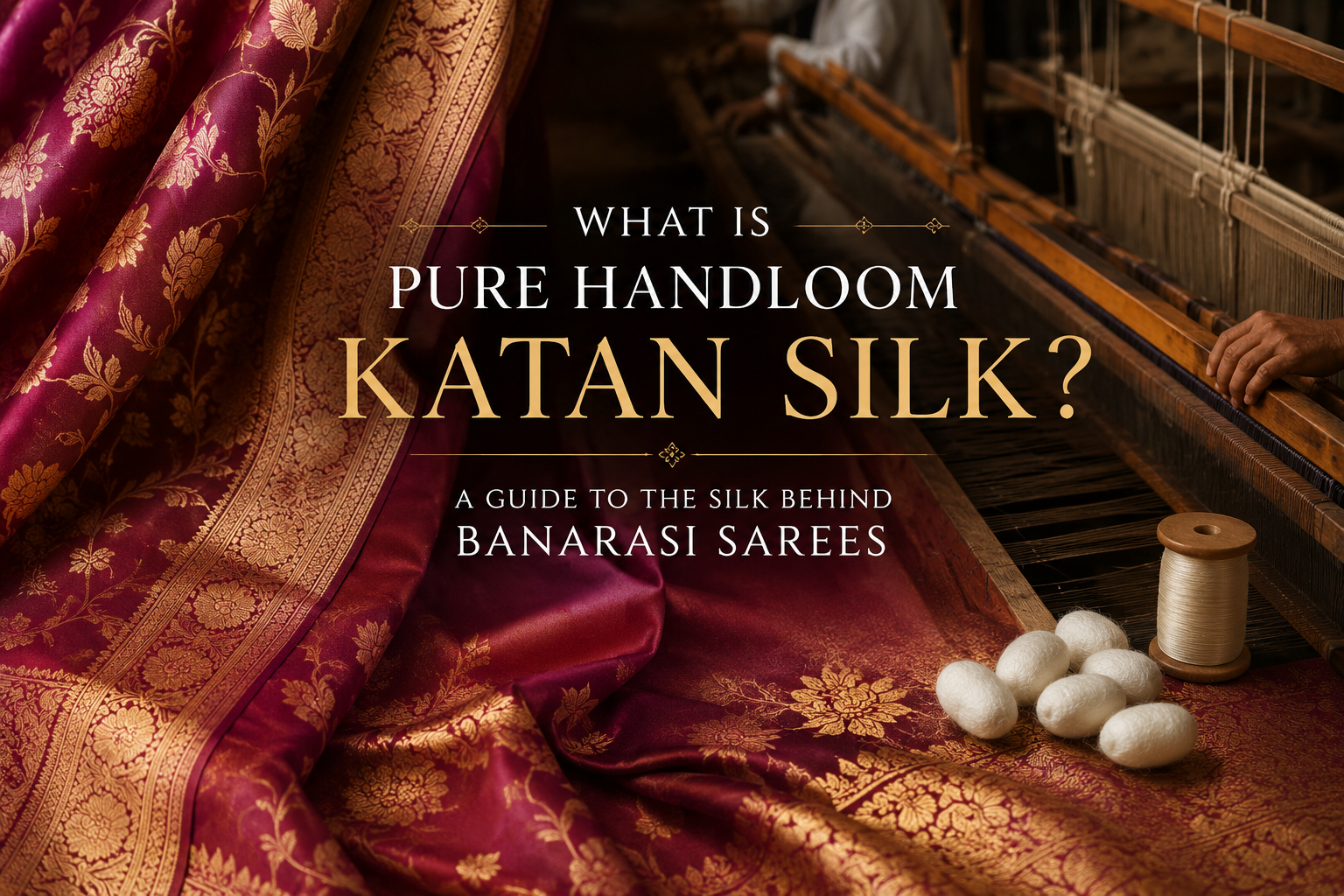
What Is Pure Handloom Katan Silk? A Guide to the Silk Behind Banarasi Sarees
There is a particular moment when you first handle a good Katan silk saree.
It isn’t necessarily the shine that catches your attention. It is the way the fabric falls. It has a certain body without feeling stiff, and a smoothness that feels different from the glossy finish of many synthetic silks.
Then you look more closely at the fabric and realise that the silk itself is only part of the story.
Katan is a yarn. Banarasi is a weaving tradition.
The two are often mentioned together, but they aren’t interchangeable terms. A Banarasi saree can be woven using different types of silk and techniques, while Katan silk refers specifically to a type of silk yarn traditionally used in Banaras weaving.
Understanding that distinction makes it much easier to appreciate what you’re actually buying.
So, what exactly is pure Katan silk? How is it different from other silks? And when a saree is described as “pure Katan handloom”, what should you look for?
Let’s start with the silk itself.
What Is Katan Silk?
Katan silk is traditionally made by twisting together two strands of silk yarn to create a stronger, smoother yarn suitable for weaving.
The resulting yarn has a clean surface and a characteristic sheen. When woven carefully, it produces fabric with a smooth hand feel, a graceful drape and enough structure to hold detailed designs.
Katan is particularly associated with Banarasi weaving, where it has traditionally been used to create both richly decorated sarees and more understated pieces.
One useful distinction is that Katan describes the yarn or silk construction, while Banarasi describes the textile tradition and place of weaving.
So when you see the phrase Katan Silk Banarasi, it generally tells you two things: the saree uses Katan silk and belongs to the Banarasi weaving tradition.
How Is Katan Silk Made?
Silk begins much earlier than the loom.
The raw silk filament is obtained from the cocoon of the silkworm and processed into usable silk yarn. For Katan, silk yarns are twisted together to produce the characteristic yarn used in weaving.
The quality of the final saree depends on several factors, including the quality of the silk, the preparation of the yarn and the way it is woven.
This is one reason two sarees both labelled “Katan silk” can feel quite different.
The label tells you something about the yarn, but it doesn’t tell you everything about the quality or craftsmanship of the finished saree.
Katan Silk and Banarasi Weaving: What’s the Connection?
This is where things get interesting.
Banaras has developed a remarkably diverse weaving vocabulary over centuries. Silk, zari, brocade techniques and intricate motifs have been combined in countless ways to create sarees that we now broadly call Banarasi.
Katan silk became particularly well suited to this tradition because its smooth, strong yarn works beautifully with detailed weaving and zari.
The result can range from a relatively simple Katan saree with a woven border to elaborate brocade pieces covered in intricate motifs.
This is why saying simply, “Katan means Banarasi,” isn’t quite accurate.
Katan is one of the materials traditionally used in Banarasi weaving.
What Does a Pure Katan Silk Saree Feel Like?
If you’ve handled silk sarees made from different fibres, you’ll notice that Katan has its own character.
A well-made Katan silk saree generally has:
- A smooth surface
- A natural silk lustre rather than a plastic-looking shine
- Good drape
- A comfortable weight
- Enough structure to hold woven motifs and zari
- A relatively refined, clean texture
But don’t use feel alone to determine whether a saree is pure silk.
Synthetic fabrics can be engineered to imitate the appearance and even some of the tactile qualities of silk remarkably well.
If authenticity matters to you, ask the seller about the fibre, certification and source rather than relying entirely on how the saree feels in your hands.
Why Does Katan Work So Well for Banarasi Sarees?
There is a practical reason behind its popularity.
Katan silk has the strength and smoothness needed for weaving detailed patterns while retaining the fluidity expected from a saree.
It also provides a good base for zari work.
Traditional Banarasi weaving can involve motifs inspired by flowers, leaves, vines, birds, paisleys and geometric forms. With Katan silk, these designs can be woven into a fabric that has enough body to show the pattern clearly without losing the natural movement of silk.
The combination is particularly appealing for occasion sarees because the fabric can look dressed up without requiring excessive surface embellishment.
Katan Silk Isn’t Just About Shine
Silk is often marketed almost entirely through its lustre.
But if you’re buying a Katan saree, look beyond the shine.
Pay attention to the drape, weight, texture and quality of the weave.
A good Katan saree doesn’t need to look mirror-like to be luxurious. Its appeal can be much quieter: the way the fabric moves, how the woven motifs sit against the silk and how comfortably it falls when worn.
This is especially useful to remember when shopping online, where photographs can exaggerate shine and colour.
The more you understand the fabric itself, the less likely you are to judge it purely by a carefully lit product photograph.
Pure Katan Silk vs “Katan Silk”: What Should You Ask?
The word Katan can sometimes be used rather loosely in the marketplace.
If you’re buying a saree described as pure Katan silk, ask a few straightforward questions:
Is the saree made entirely from silk?
Is it handwoven?
Where was it woven?
Does it carry Silk Mark certification, where applicable?
Can you provide details about the weaving cluster or artisan?
None of these questions are difficult, and a transparent seller should be comfortable answering them.
The more expensive the saree, the more reasonable it is to expect clear answers.
And that’s really the point of understanding Katan.
You don’t need to become a silk technologist before buying a saree. You simply need enough knowledge to distinguish a specific textile tradition from the marketing language surrounding it.
How Is Pure Katan Silk Different From Other Banarasi Silks?
“Katan silk” is only one part of the Banarasi vocabulary.
Banarasi sarees can be made using different silk varieties and constructions, and the choice affects how the saree feels, falls and looks.
Katan is known for its smooth, relatively fine yarn and graceful drape. Other silks may have a different texture, weight or surface character.
This is why choosing a Banarasi saree shouldn’t begin with the assumption that one silk is automatically better than another.
It should begin with what you like to wear.
If you prefer a saree with a smooth fall and understated silk sheen, Katan can be an excellent choice. If you want something lighter, more textured or more heavily patterned, another Banarasi silk may suit you better.
The word pure should also be treated carefully. It is useful only when you know what it refers to: the fibre composition, rather than a vague promise of premium quality.
What Makes Handloom Katan Different?
Now we come to an important distinction.
Pure silk does not automatically mean handloom.
A saree can be made from genuine silk and still be woven on a powerloom.
A handloom Katan saree, by contrast, combines the characteristics of Katan silk with manual weaving. The design is constructed on the loom through the skill of the weaver rather than being mechanically reproduced at industrial speed.
You may notice small variations in the weave or motifs. These are natural characteristics of handwoven textiles, not something that needs to be “corrected”.
This is also why two handloom Katan sarees made from the same design can have small differences between them.
They belong to the same family.
They don’t have to be identical.
How to Choose a Katan Silk Saree Without Getting Lost in Terminology
Saree shopping can become surprisingly confusing once terms such as Katan, Katan silk, Banarasi, brocade, zari and pure silk start appearing together.
You don’t need to understand every technical term.
Instead, ask four basic questions:
What is the fibre?
Is it pure silk, a silk blend or a synthetic fibre?
How was it woven?
Is it handloom or powerloom?
Where was it woven?
A genuine Banarasi should have a connection to the Banaras weaving tradition.
What certification or documentation is available?
For silk, the Silk Mark can provide additional assurance about silk content where applicable.
These questions help separate the actual characteristics of the saree from the language used to sell it.
Is Katan Silk Suitable for Everyday Wear?
It can be, although most people tend to reserve richly woven Katan sarees for occasions.
A simpler Katan silk saree with minimal zari can work beautifully for dinners, festive gatherings and work events where you want something more refined than everyday cotton but less elaborate than a heavily brocaded wedding saree.
Heavier Katan Banarasis are better suited to weddings and formal occasions.
The advantage is versatility. A classic Katan saree doesn’t depend on a particular fashion trend to look appropriate.
Change the blouse, jewellery and styling and the same saree can feel completely different.
How to Care for a Katan Silk Saree
Silk deserves a little more attention than everyday cotton, but caring for it doesn’t need to become complicated.
Store it dry.
Moisture can damage silk and zari over time.
Avoid prolonged exposure to direct sunlight.
Strong sunlight can gradually affect dyes and weaken natural fibres.
Don’t use harsh detergents.
Silk fibres are delicate and are better handled by professional dry cleaning when cleaning is necessary.
Fold it differently from time to time.
Changing the fold can help prevent permanent creases along the same lines.
Use breathable storage.
Avoid leaving silk sealed in plastic for long periods.
And if the saree has zari, extra care is worthwhile. Keeping it clean, dry and protected from friction will help preserve its finish.
The goal isn’t to treat a saree like a museum object.
It is to look after it well enough that you can actually enjoy wearing it for years.
Handloom Wisdom – Don’t judge a silk saree by its shine alone.
A strong synthetic sheen can look impressive under shop lights, while a finely woven natural silk may have a softer lustre.
Look at the drape, texture, fibre, weave and construction together. A saree becomes much easier to evaluate once you stop treating shine as the shortcut to quality.
Behind the Loom: Why Katan Still Matters
Katan silk is interesting not only because of how it looks, but because of the relationship between the yarn and the Banarasi loom.
The weaver works with the characteristics of the silk rather than simply decorating a finished piece of fabric. The yarn, tension, motifs and zari all have to work together as the saree is constructed.
That knowledge is difficult to separate from the weaving community itself.
A Banarasi saree is therefore not simply a silk product from a particular city. It represents a body of weaving knowledge that has developed over generations.
When buyers understand that distinction, terms such as Katan silk and Banarasi stop being marketing vocabulary and start becoming useful information.
That is one reason we at Woh Chali prefer to tell customers not only what a saree is made from, but where and how it was woven.
The Woh Chali Perspective
At Woh Chali, we don’t think buying a Katan silk saree should require you to take someone’s word for it.
You should know what you’re buying.
That means being clear about the silk, the weaving tradition, the place of origin and the craftsmanship involved. Our Katan silk sarees are sourced from traditional Banarasi weaving clusters, with a focus on authentic handloom craftsmanship rather than simply using “Banarasi” or “Katan” as a sales label.
We also believe luxury is more meaningful when the value of the saree is understood at both ends of the supply chain: by the person weaving it and by the person eventually wearing it.
A good saree doesn’t need an exaggerated story.
Its construction, provenance and craftsmanship should be enough.
Wrapping up
Katan silk can seem complicated when reduced to the terminology used in saree catalogues.
It becomes much simpler when you break it down.
Katan refers to the silk yarn. Banarasi refers to a rich weaving tradition associated with Banaras. Handloom tells you how the saree was woven.
Put those pieces together and you have a much clearer picture of what you’re buying.
And perhaps that is the most useful lesson when shopping for any traditional textile.
Don’t buy a saree simply because it has the right words attached to it.
Understand those words.
Ask questions.
Look closely.
Then choose the one you genuinely want to wear.
Frequently Asked Questions
- What is pure Katan silk?
Katan silk traditionally refers to silk yarn made by twisting together silk strands to create a smooth, strong yarn. It is closely associated with Banarasi weaving and is widely used for making silk sarees with a smooth texture, graceful drape and natural lustre.
- Is Katan silk the same as Banarasi silk?
Not exactly. Katan refers to the type or construction of silk yarn, while Banarasi refers to a weaving tradition associated with Banaras. Katan silk is traditionally used to weave many Banarasi sarees, but the two terms do not mean the same thing.
- Is pure Katan silk always handloom?
No. Genuine silk and handloom describe two different things. A saree can be made from pure silk but woven on a powerloom. If you specifically want a handloom Katan saree, ask whether it was manually woven and where it was produced.
- How can I tell if Katan silk is pure?
Don’t rely on appearance or touch alone. Ask about the fibre composition, place of weaving and available certification. For silk products, a Silk Mark can provide additional assurance of silk content where applicable. A transparent seller should also be able to explain what they mean by “pure Katan silk.”
- Is Katan silk good for weddings?
Yes. Katan silk is particularly popular for formal and festive sarees because of its smooth drape, natural lustre and compatibility with intricate Banarasi weaving and zari work. Simpler Katan sarees can also be styled for less formal occasions.
- How should I care for a Katan silk saree?
Keep it away from prolonged direct sunlight and moisture, avoid harsh detergents and use professional dry cleaning when cleaning is required. Store it in a breathable fabric covering and refold it periodically to avoid stressing the same fold lines.
- Why are Katan silk Banarasi sarees expensive?
The final price depends on several factors, including silk quality, weaving technique, design complexity, zari, craftsmanship and the supply chain. A handwoven Katan Banarasi also involves considerably more manual skill than a machine-produced silk saree. Price alone, however, should never be treated as proof of authenticity.
