

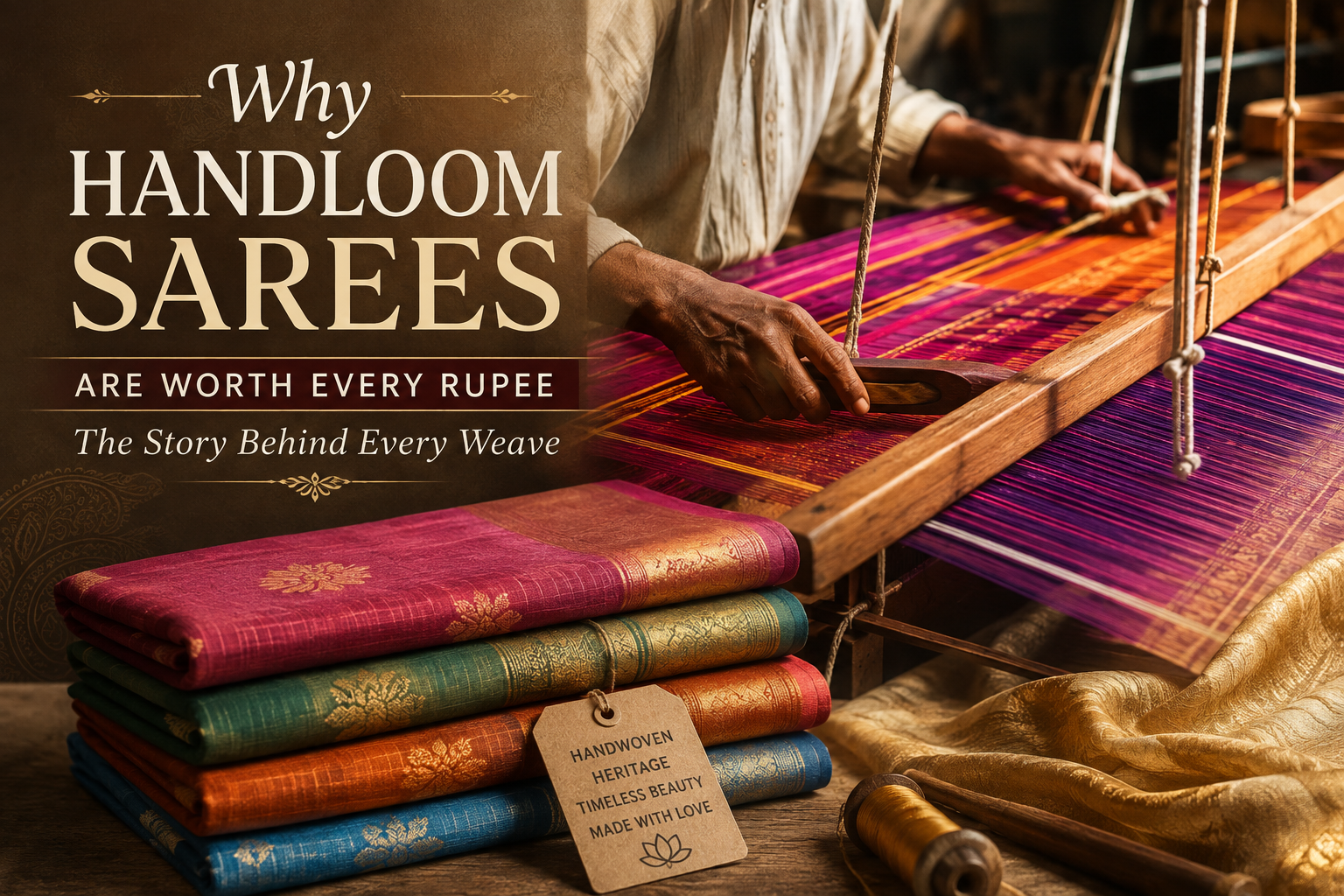
“₹20,000 for a saree?”
It is a fair question.
A handloom saree can cost considerably more than a machine-made version sitting beside it. And when the two look similar in a photograph, the difference can seem difficult to justify.
But price and value are not always the same thing.
A handloom saree takes a very different route from loom to wardrobe. There is the yarn, the dyeing, the preparation of the loom, the design, the weaving itself and the finishing. Behind those stages is a person who has spent years learning how to do something that cannot be mastered by watching a machine run.
Then there is what happens after you buy it.
A good handloom saree does not have to disappear when the season changes. It can be worn to a wedding today, a family celebration five years from now and perhaps by someone else in your family twenty years after that.
That is where the real conversation about the price of handloom should begin.
What Are You Really Paying For When You Buy a Handloom Saree?
It is tempting to think of a saree as a finished product and its price as a simple combination of fabric, design and brand markup.
Handloom doesn’t work quite that way.
You are also paying for time and specialised knowledge.
Before an artisan starts weaving, the yarn needs to be prepared and the loom set up. Depending on the technique, the process can involve careful arrangement of the warp, preparation of the weft, dyeing, motif planning and other specialised steps. Once weaving begins, the artisan has to maintain the right tension and rhythm throughout the fabric.
A complex saree can take days or weeks to complete.
And the skill involved isn’t something that can simply be replaced when a machine becomes available. Traditional weaving techniques are learned through years of practice, often within families and local weaving communities.
This is why the price of an authentic handloom saree should not be compared only with the price of another saree made from a similar fibre.
The more useful comparison is between how something is made and what goes into making it.
Why Does Handloom Cost More Than Mass-Produced Fashion?
The simplest answer is time.
A machine can repeat the same design at considerable speed. An artisan cannot, because the loom depends on human movement and attention.
That difference in production speed has a direct effect on cost.
Mass production spreads manufacturing costs across thousands of identical pieces. Handloom production is naturally limited. A weaver cannot suddenly produce 500 sarees overnight because demand has increased.
That limitation is part of the value.
It also explains why authentic handloom collections are often available in relatively small quantities. A limited number of pieces isn’t necessarily a marketing strategy. Sometimes it is simply the reality of how long the loom takes.
There is another important distinction, too.
Handloom is labour-intensive, but that does not automatically mean the artisan should earn less.
The people creating the most time-intensive part of the product should not be the easiest part of the supply chain to squeeze.
Is a More Expensive Saree Always Better?
No.
This is an important distinction that the handloom industry needs to make more often.
A high price does not automatically mean a saree is handwoven, and a lower price does not automatically mean it is poorly made. Retail pricing can include branding, store overheads, distribution, marketing and multiple layers of margins.
That is why buyers should be cautious about using price as a shortcut for authenticity or quality.
A ₹40,000 saree isn’t necessarily better than a ₹15,000 saree simply because the price is higher.
What matters is what sits behind the price.
What is the fabric?
How was it woven?
Where was it made?
Who made it?
How much of the final price reached the artisan?
Those questions tell you considerably more than a premium price tag ever could.
The Real Cost of Fast Fashion
There is another way to understand the value of handloom: look at what happens when clothing is made primarily for speed and volume.
Fast fashion has made it possible to buy new clothes constantly and cheaply. That convenience has changed our expectations. New collections appear quickly, trends have shorter lives and garments can become disposable almost by design.
The problem isn’t that affordable fashion exists.
The problem is the habit of buying more clothing than we need, wearing it a handful of times and replacing it because something newer has appeared.
Much of today’s clothing is also made from synthetic fibres, including polyester, which are derived from fossil fuel feedstocks and do not biodegrade in the way natural fibres do.
Handloom offers a different model.
A saree can be bought less frequently, worn repeatedly and maintained carefully. Instead of asking how quickly you can replace it, the question becomes how long you can enjoy it.
That is the thinking behind slow fashion.
Buy fewer pieces. Choose them carefully. Wear them often. Keep them for longer.
For a handloom saree, this isn’t a new trend. It has always been part of the logic of the garment.
What Does “Cost Per Wear” Tell Us?
Consider two hypothetical wardrobes.
You buy one handloom saree for ₹20,000 and wear it 40 times over ten years.
That works out to ₹500 per wear.
Now consider buying five ₹4,000 sarees over the same period because the earlier ones no longer feel relevant. The initial spend is the same, but the purchasing cycle is very different.
And cost per wear isn’t the only consideration.
The handloom saree may still be wearable ten years later. It may carry memories of a wedding, a festival or an important family occasion. It may eventually be passed to someone else.
That doesn’t make every expensive saree a good investment.
It does show why longevity changes the meaning of price.
Why Handmade Will Never Be About Speed
There is a reason handloom weaving has survived despite the arrival of industrial textile production.
People value what machines cannot completely replace.
A skilled weaver develops an understanding of yarn, tension, colour and pattern that becomes almost instinctive. A particular border might require a specific sequence of movements. A complicated motif may need constant attention.
The longer you look at the process, the harder it becomes to see the saree as merely fabric.
It is the accumulated result of expertise.
And that expertise deserves to be priced fairly.
Where Your Money Goes Matters
The price you pay for a saree does not necessarily tell you what the person who made it earned.
Traditional supply chains can involve several stages between the loom and the customer. A saree may pass from a weaver to a trader, then through wholesalers, distributors and retailers before reaching its final buyer. Each layer can add its own margin and operating costs.
At the same time, large buyers purchasing hundreds of pieces can have considerable negotiating power over the price they pay at the sourcing stage.
This is where the economics of handloom becomes important.
A saree can be expensive for the customer without being particularly profitable for the artisan.
That is not the model Woh Chali wants to follow.
We work directly with weaving communities and purchase limited, carefully selected pieces rather than placing enormous bulk orders. Our artisan partners typically earn 20 to 25 per cent more than what they receive from many large-scale buyers, because we don’t use volume as a reason to push their prices down.
The customer benefit comes from a different place.
We reduce unnecessary layers and retail markups, allowing us to offer authentic handloom sarees at around half to one-fourth the price of sarees made from comparable fabrics in traditional large retail and luxury channels, without cutting into the weaver’s earnings.
That distinction matters.
Lower customer prices do not have to mean lower artisan wages.
A more efficient supply chain can create better economics at both ends.
And for a craft that depends on skilled people continuing to weave, that is essential.
Can One Handloom Saree Really Last a Lifetime?
It can, provided it is made well and cared for properly.
Silk, cotton and other natural fibres have different care requirements, but a thoughtfully woven saree can remain part of a wardrobe for decades. That is one reason handloom has traditionally been associated with heirloom dressing in India.
A saree worn by a mother can become a daughter’s wedding saree. A grandmother’s Banarasi can return to the wardrobe years later for another celebration. The fabric becomes part of the family’s history rather than something that simply moves out of fashion.
This is where handloom and fast fashion represent two very different approaches to clothing.
Fast fashion asks what you want next.
Handloom asks what you want to keep.
What Happens When We Buy Fewer, Better Sarees?
Buying fewer clothes does not mean having a boring wardrobe.
It can mean becoming more selective about what earns a place in it.
A handloom saree can be styled differently, worn across occasions and paired with contemporary blouses, jewellery or accessories. Its value comes partly from its ability to move beyond a particular season or trend.
That matters because sustainability isn’t only about the material a garment is made from. It is also about how long we keep and use it.
A saree that is worn for years is fundamentally different from one bought because it is inexpensive, worn twice and forgotten.
This is why slow fashion is such a natural fit for handloom. It encourages us to pause before buying, understand what we’re purchasing and choose pieces that have a reason to stay.
Does Buying Handloom Really Help Preserve Indian Weaving Traditions?
Yes, but only when the economics work for the people doing the weaving.
Admiring a craft is not enough to keep it alive.
If weaving no longer provides a viable livelihood, younger members of artisan families have little reason to learn the craft. Over time, techniques become harder to pass on and entire weaving traditions can shrink.
That is why the price paid at the loom matters.
At Woh Chali, we believe preservation has to begin with fair compensation. We work directly with weavers, purchase limited quantities and pay fair prices rather than using large-volume orders to negotiate their earnings downward.
Our approach also means that customers can access genuine handloom at considerably lower prices than many traditional luxury retail channels, because the saving comes from a leaner supply chain and lower markups, not from paying the artisan less.
That is the model we believe can make handloom more sustainable as a profession.
Handloom and the Future of Conscious Fashion
There is no need to stop enjoying fashion to become a more conscious shopper.
The more useful change is to stop treating every trend as a reason to buy something new.
A thoughtful wardrobe can include contemporary clothing alongside traditional textiles. What matters is whether the pieces are made well enough and loved enough to stay in rotation.
Handloom naturally fits this approach.
It isn’t produced at the speed of a trend cycle. It comes from techniques that have already survived generations. Its appeal isn’t dependent on being new every season.
And perhaps that is precisely why it continues to feel relevant.
Handloom Wisdom
The price of a handloom saree is paid when you buy it. Its value is realised every time you wear it.
The calculation becomes even more meaningful when a saree is worn for years, repaired or cared for rather than discarded, and eventually passed to someone else.
Behind the Loom: The Economics Few Buyers See
Imagine a saree travelling through several hands before reaching you.
A weaver creates it. A trader buys it. A wholesaler may purchase it next. A distributor moves it to another market. A retailer finally sells it to the customer.
Every stage needs to make money.
The person at the beginning of that chain, however, may have the least negotiating power.
This is particularly important when large buyers place orders running into hundreds of pieces. Their scale can give them significant leverage when negotiating procurement prices.
Woh Chali takes a different approach.
We buy limited pieces directly from weaving communities and pay our artisan partners fairly, with their earnings typically 20 to 25 per cent higher than what they receive from many bulk buyers. Because we are not purchasing hundreds of identical pieces, we also preserve the individuality that makes handloom special.
We then pass a significant part of the supply-chain saving to customers.
This creates a useful middle ground: the weaver earns more, the customer pays less and the craft remains commercially viable.
That is a much more meaningful definition of value than simply finding the cheapest saree.
The Woh Chali Perspective
We don’t believe a handloom saree should be expensive simply because it carries the word “handloom.”
Its price should make sense.
The artisan should be paid fairly. The customer should receive genuine value. The saree should be good enough to deserve a long life.
That is why Woh Chali works directly with weaving communities and keeps collections deliberately limited. We aren’t trying to make thousands of identical sarees available. We want to bring you pieces that retain the character of the craft and the people who created them.
Our aim is simple: make authentic Indian handloom more accessible without making the artisan pay for that accessibility.
Because if the person behind the loom cannot earn a fair living from weaving, the tradition itself is at risk.
Conclusion
A handloom saree can cost more than a mass-produced saree.
But the better question isn’t simply, “Why is it expensive?”
Ask what went into making it.
Ask how long it took.
Ask who wove it.
Ask whether the artisan was paid fairly.
Ask how many times you can imagine wearing it.
Those questions change the calculation.
Handloom isn’t about buying more expensive clothing. It is about buying with more intention, choosing craftsmanship over disposability and allowing something made slowly to remain in your wardrobe for a long time.
The next time you consider a saree, don’t only look at the price tag.
Look at the loom behind it.
FAQs
- Why are handloom sarees more expensive than machine-made sarees?
Handloom sarees are labour-intensive and can take days or weeks to weave depending on their fabric, motifs and construction. Their price reflects skilled artisan labour, yarn quality, preparation and limited production rather than simply the cost of the finished fabric. However, a higher retail price does not automatically mean an artisan has earned more. Supply-chain margins can significantly influence the final price.
- Are handloom sarees worth the investment?
For buyers who value longevity, craftsmanship and slow fashion, handloom sarees can offer excellent long-term value. A well-made saree can be worn repeatedly for years and may eventually become an heirloom. Instead of measuring value only by the initial price, consider cost per wear, quality, versatility and how long you expect to keep the saree.
- Do weavers earn less when brands sell handloom sarees at lower prices?
Not necessarily. The customer’s price and the artisan’s earnings can both improve when a brand removes unnecessary supply-chain costs rather than negotiating the artisan’s price downward. Woh Chali works directly with weaving communities, buys limited quantities at fair prices and typically pays its artisan partners 20 to 25 per cent more than what they receive from many bulk buyers.
- Is handloom better for slow fashion than fast fashion?
Handloom naturally aligns with slow fashion because it is produced at a slower pace, is often made from natural fibres and can remain in use for many years. Its limited production also discourages the idea that clothing needs to be constantly replaced. Buying fewer, well-made sarees and wearing them repeatedly is a more considered alternative to frequent, trend-driven consumption.
- How long can a handloom saree last?
There is no single lifespan for every handloom saree. It depends on the fibre, weaving quality, dyeing, zari, frequency of use and care. Well-maintained silk and cotton handloom sarees can last for decades. Proper storage, appropriate cleaning and protection from moisture, direct sunlight and harsh chemicals can significantly extend their usable life.
- Why can Woh Chali offer handloom sarees at lower prices?
Woh Chali focuses on direct sourcing, limited collections and a leaner supply chain. Instead of using large-volume procurement to push down the price paid to weavers, the brand aims to pay artisan partners fairly and reduce unnecessary intermediary and retail markups. This allows customers to access authentic handloom at a substantially lower price than comparable fabrics sold through conventional luxury retail channels.
