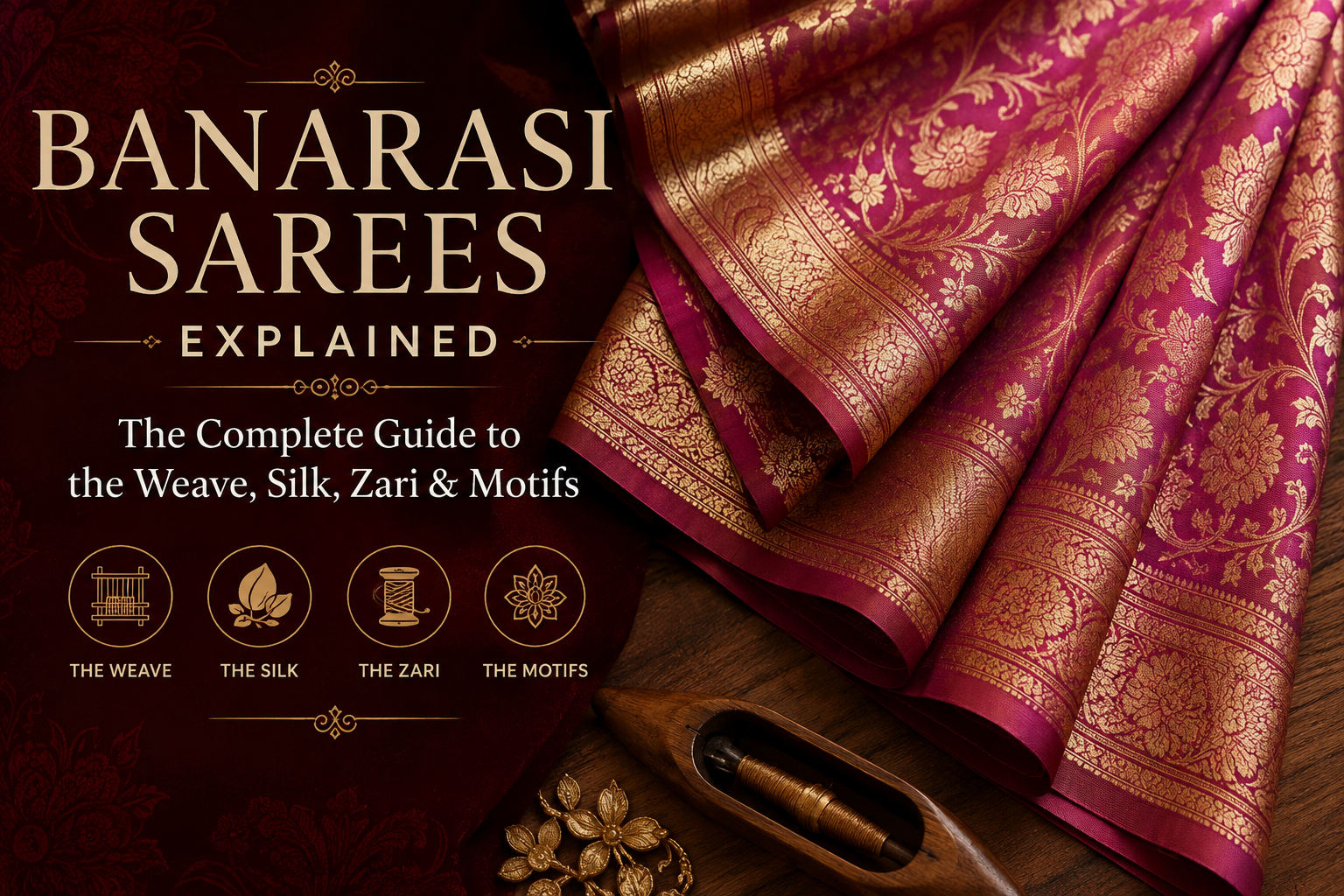
There are few sarees in India that need less introduction than a Banarasi.
You may already have one tucked away in your mother’s cupboard. Perhaps you wore one at a wedding, admired one behind a glass counter, or spent an evening trying to understand why two sarees labelled “Banarasi silk” could have such different prices.
The confusion is understandable.
Katan. Kora. Tissue. Zari. Jangla. Kadwa. Meenakari.
A saree can come with quite a vocabulary attached to it.
But these aren’t simply fancy words used to make a saree sound more valuable. Each describes something about the material, construction, design or technique.
Once you understand those differences, shopping for a Banarasi becomes much easier.
And you begin to notice things you might previously have overlooked: the way a motif is woven, the quality of the silk, the construction of the zari and even the reverse side of the saree.
What Is a Banarasi Saree?
A Banarasi saree is a textile associated with Banaras, also known as Varanasi, in Uttar Pradesh, and its long-established silk-weaving tradition.
Banarasi weaving is particularly known for richly patterned fabrics incorporating silk and zari, often using brocade techniques to create floral, geometric and nature-inspired motifs.
But there is an important distinction worth making at the outset:
Not every saree sold as “Banarasi” is necessarily handwoven.
Banarasi refers to a weaving tradition and place of origin. A Banarasi-style saree can also be produced on a powerloom.
If you’re specifically looking for a handloom Banarasi, you need to establish both things: that the saree belongs to the Banarasi tradition and that it was actually woven on a handloom.
We’ve explored that distinction in detail in our guide to [handloom vs powerloom sarees].
A Short History of Banarasi Weaving
Banaras has been an important centre of textile production for centuries, although the history of its silk weaving is not as simple as one single craft arriving at one particular moment.
The weaving tradition that developed in the region was influenced by several strands of Indian textile knowledge, including techniques and decorative ideas that evolved during the Mughal period.
Persian-influenced floral designs became part of the visual vocabulary of Banarasi textiles, alongside Indian motifs and local weaving practices.
Over time, Banaras developed a specialised ecosystem of silk weavers, designers, dyers and other craftspeople.
The sarees produced here became particularly associated with ceremonial dressing and weddings, but the tradition has never been limited to heavily embellished bridal pieces.
There are quiet Banarasis too.
A fine Katan silk saree with a narrow zari border. A lightly patterned Butidar. A subtle tissue weave.
The Banarasi tradition is much broader than the heavily brocaded wedding saree most people first picture.
What Makes a Banarasi Saree Different?
There isn’t one feature that defines every Banarasi.
Instead, its character comes from the interaction between silk, weaving technique, zari and design.
The Silk
Silk is central to the Banarasi tradition, but “Banarasi silk” isn’t a single type of silk.
Different silk varieties and constructions are used, each producing a different texture, weight and drape.
Katan silk, for example, is traditionally made using twisted silk yarns and is particularly well suited to detailed Banarasi weaving. Its smooth surface and graceful fall make it one of the most recognisable choices for Banarasi sarees.
We’ve explored Katan in detail in our previous article, [What Is Pure Handloom Katan Silk?].
Other Banarasi sarees may use Kora, organza, georgette or tissue constructions, depending on the desired appearance and drape.
This is why simply asking whether a saree is “Banarasi silk” doesn’t tell you enough.
Ask what silk or fibre has actually been used.
The Zari
Then there is zari.
That unmistakable metallic thread is one of the features most closely associated with Banarasi textiles.
Traditionally, zari involved a metallic strip wound around a core thread. Historically, precious metals such as gold and silver were used in fine zari, although modern zari is also produced using other metallic materials.
The quality and composition of zari can therefore vary considerably.
Two sarees can both have a “golden” border while differing significantly in their materials, construction and price.
This is worth remembering when shopping for a Banarasi: the presence of zari alone doesn’t tell you its quality.
The Brocade
Brocade refers broadly to a decorative weaving technique in which additional threads are used to create patterns within the fabric.
In a Banarasi saree, these patterns can cover a small section or much of the surface.
The important point is that the design isn’t simply sitting on top of the fabric like a printed image.
It is constructed through weaving.
That’s what gives a traditionally woven brocade saree its particular depth and character.
The Different Types of Banarasi Sarees
Walk into a Banarasi weaving cluster and you quickly realise that “Banarasi saree” is an umbrella rather than a single category.
The differences can come from the silk, the weave, the amount of zari and the type of pattern.
Katan Silk Banarasi
Katan silk is one of the best-known choices for Banarasi sarees.
It has a smooth surface, natural silk lustre and a graceful fall. Depending on the design, a Katan Banarasi can be relatively understated or densely patterned with zari and brocade.
For a detailed explanation of Katan silk, our previous guide goes deeper into the yarn, its characteristics and what to look for when buying it.
Kora Silk Banarasi
Kora silk has a lighter, more translucent character and is often chosen for sarees where the fabric itself is meant to feel airy and delicate.
Its slightly different texture gives Kora Banarasis a look that is quite distinct from the richer appearance of many Katan pieces.
It can work particularly well when you want the detailing of a Banarasi without the weight of a heavily woven saree.
Organza Banarasi
Organza is known for its crisp, lightweight and translucent quality.
A Banarasi woven on an organza base can look quite different from a traditional heavy silk Banarasi. The motifs and zari become especially prominent against the sheer ground.
It is often a good choice for someone who likes the visual language of Banarasi but prefers a lighter saree.
Georgette Banarasi
Georgette has a softer, more fluid drape.
Banarasi weaving techniques applied to a georgette base can therefore create sarees that feel less structured and move more easily with the body.
Tissue Banarasi
Tissue Banarasis have a distinctive metallic appearance created through the use of zari-rich weaving.
They catch light differently from plain silk and can be particularly striking for evening occasions.
However, as with Katan and Kora, the name alone isn’t enough to determine the exact fibre composition. When buying, ask the seller what the base fabric and metallic threads actually contain.
The names may sound complicated at first.
But once you separate the fabric from the weaving technique and the design, Banarasi terminology becomes much easier to understand.
And that’s important, because the next thing to learn is perhaps the most enjoyable part: how to read the designs themselves.
In Part 2, we’ll look at the motifs that make Banarasi textiles recognisable, explore techniques such as Kadwa and Meenakari, explain what affects the price of a Banarasi saree, and show you how to choose one without getting lost in labels.
Banarasi Motifs: Learning to Read the Saree
One of the pleasures of looking at a Banarasi saree is realising that its motifs aren’t simply decoration. Many belong to a design vocabulary that has been used and adapted by Banarasi weavers for generations.
You don’t need to memorise all of them. Knowing a handful can make it much easier to understand what you’re looking at.
Buti and Butidar
A buti is a small motif woven repeatedly across the saree.
When a saree is covered with these small repeated motifs, it is often described as Butidar.
The motifs may be floral, geometric or inspired by nature. Because they are relatively small, Butidar sarees can offer the richness of a Banarasi without covering the entire fabric in dense patterning.
Jangla
Jangla is one of the more recognisable Banarasi design styles.
It typically features larger, flowing floral and vine patterns spreading across the saree. The design can feel abundant without necessarily being dominated by a conventional border-and-pallu arrangement.
A Jangla saree is usually a good choice for someone who wants the weaving itself to be the main feature.
Bel
A bel is a vine-like design, commonly used along borders or as part of a larger composition.
You’ll often see flowers, leaves and curling stems arranged in repeating patterns.
Ashrafi
The Ashrafi motif takes its inspiration from coin-like circular forms.
It can appear as a repeated buti or as part of a larger design arrangement.
Meenakari
Meenakari refers to the use of coloured threads alongside zari to create additional colour and detail within woven motifs.
The effect can range from subtle touches of colour to much more elaborate multicoloured designs.
These terms aren’t just useful for shopping. They give you a vocabulary for appreciating the work itself.
How Is a Banarasi Saree Woven?
The finished saree can look almost effortless.
The process is anything but.
Before weaving begins, the yarn needs to be prepared and the loom carefully set up. The warp threads have to be arranged correctly, and the weaver needs to establish the structure required for the particular design. For patterned Banarasis, the design itself also needs to be translated into instructions that the loom can follow.
Then comes the weaving. The weaver gradually builds the fabric, working the silk and supplementary threads into the structure of the saree. Where zari or intricate motifs are involved, the process becomes more demanding.
Finally, the saree is finished, checked and prepared for use. The exact process varies depending on the technique and loom, so there isn’t one universal method for making every Banarasi. That’s also why two Banarasi sarees can look completely different while belonging to the same broad weaving tradition.
What Is Kadwa Weaving?
If you come across the word Kadwa while shopping for Banarasi sarees, it is worth paying attention. In Kadwa weaving, motifs are individually woven into the fabric using supplementary weft threads rather than simply carrying the design mechanically across the full width of the saree. This allows the weaver considerable control over individual motifs.
One visible characteristic is the relatively clean reverse side compared with certain other brocade constructions, because unnecessary floating threads can be avoided.
The process is also labour-intensive. This is one reason a finely woven Kadwa Banarasi can command a higher price than a saree produced using a faster technique. It is a useful reminder that even within the category of “handloom Banarasi”, the technique used can make a substantial difference.
Why Do Banarasi Sarees Vary So Much in Price?
You can find Banarasi sarees at dramatically different prices, and there isn’t necessarily anything suspicious about that.
The price can depend on:
- Type and quality of silk
- Handloom or powerloom construction
- Weaving technique
- Complexity of the design
- Amount and type of zari
- Number of colours used
- Time required to weave
- Finishing
- Artisan skill
- Supply-chain and retail margins
A heavily patterned handwoven Katan saree with intricate zari can require considerably more work than a simpler Banarasi with a narrow border. This is why comparing only the word Banarasi isn’t particularly useful. It’s like comparing two paintings simply because they are both paintings.
The details matter.
And just as we discussed in our guide to identifying authentic handloom, a high price by itself is not proof of authenticity.
How to Identify an Authentic Banarasi Saree
There isn’t one foolproof visual trick.
Instead, approach the purchase as you would any valuable textile.
Start by asking where the saree was woven.
Then ask what fibre has been used, whether it is handwoven and what technique has been used to create the design.
Look closely at the motifs and the reverse side of the saree. If the seller makes specific claims about silk or handloom certification, ask for the relevant documentation or mark where applicable.
And pay attention to how much information the seller is willing to share.
A knowledgeable seller should be able to explain what makes the saree a Banarasi, rather than relying on the label alone.
For a more detailed checklist, see our guide on How to Identify an Authentic Handloom Saree.
Banarasi vs Kanjeevaram vs Chanderi
India has no shortage of exceptional silk and handloom traditions, and each has its own character.
| Feature | Banarasi | Kanjeevaram | Chanderi |
| Region | Banaras, Uttar Pradesh | Kanchipuram, Tamil Nadu | Chanderi, Madhya Pradesh |
| Known for | Silk, zari and brocade | Silk, distinctive borders and contrasting colours | Lightweight, sheer texture |
| Typical feel | Smooth and richly woven | Structured and substantial | Light and airy |
| Common occasions | Weddings and festive occasions | Weddings and ceremonies | Festive, formal and everyday wear |
None is inherently better.
The right choice depends on the kind of fabric you enjoy, the occasion and how you want your saree to feel when you wear it.
Which Banarasi Saree Should You Choose?
If you’re buying your first one, don’t begin with the most elaborate saree you can find.
Begin with how you actually dress.
For a wedding, a richly woven Katan or brocade Banarasi can work beautifully.
For a reception or evening event, a lighter Katan, tissue or intricately detailed saree may offer the right balance.
For festive occasions, a Butidar or moderately zari-worked saree can be easier to wear repeatedly.
And if your taste leans towards understated clothing, don’t overlook simpler Katan Banarasis. A beautiful silk ground with a restrained border can be just as sophisticated as a heavily embellished piece.
The best Banarasi isn’t necessarily the most ornate one.
It’s the one you’ll actually want to wear.
Handloom Wisdom
When buying a Banarasi, don’t stop at “pure silk” or “handloom.” Ask what technique created the design.
Katan, Kora and other fabric descriptions tell you about the material. Kadwa, Jangla and Butidar tell you something about the construction or design.
The more specific the answer, the more you understand what you’re paying for.
Behind the Loom: The People Behind Banaras’ Weaving Tradition
Banarasi weaving survives because there are people who know how to do it.
That sounds obvious, but traditional weaving depends on specialised knowledge that can take years to develop. Particular techniques, motifs and methods of working with silk and zari are often learned within weaving communities and families.
The challenge isn’t simply preserving an old technique in a museum.
It is making sure that weaving remains a viable occupation.
That requires a market willing to value the work and buyers who understand why one saree can require substantially more skill and time than another.
At Woh Chali, we source our Banarasi sarees from traditional weaving clusters in Banaras. We try to give customers enough information to understand the fabric and the craft instead of expecting them to make a purchase based purely on photographs and adjectives.
The Woh Chali Perspective
A Banarasi doesn’t need an elaborate sales pitch. Once you understand the silk, the weaving technique, the motifs and the work involved, the saree can speak for itself.
That is how we approach Banarasi at Woh Chali. We look for pieces where the craftsmanship makes sense, where the provenance is clear and where the price reflects the saree rather than layers of unnecessary retail markup.
Our job is to make these textiles easier to understand and easier to buy with confidence. Because knowing what you’re buying is part of enjoying it.
Wrapping up
Banarasi weaving can seem complicated when you first encounter its terminology. Katan. Kora. Jangla. Butidar. Kadwa. Meenakari. Zari.
But each term gives you another way of understanding the saree in front of you. And once you start looking beyond the surface, you realise that a Banarasi isn’t defined simply by its shine or the amount of gold on it.
It is a combination of material, technique, design and skill, shaped by a weaving tradition that has continued to evolve in Banaras. So, the next time you find yourself looking at a Banarasi, look a little longer.
Look at the motifs.
Turn it over.
Ask what the silk is.
Ask how it was woven.
Then decide whether it is a saree you want to own.
Frequently Asked Questions
- What is a Banarasi saree?
A Banarasi saree is a textile associated with the weaving tradition of Banaras in Uttar Pradesh. Banarasi textiles are particularly known for silk, zari, brocade weaving and intricate motifs. Importantly, not every saree marketed as Banarasi is handwoven, so buyers should check the weaving method if authenticity is important to them.
- Are all Banarasi sarees handloom?
No. Banarasi describes a regional textile and weaving tradition, not automatically the method of production. Both handloom and powerloom Banarasi sarees are available. If you specifically want a handloom Banarasi, ask the seller about the loom, place of weaving and relevant certification where applicable.
- What is Katan silk in a Banarasi saree?
Katan silk is a type of silk yarn traditionally associated with Banarasi weaving. It is known for its smooth texture, natural lustre and graceful drape. Katan is a material, while Banarasi refers to the broader weaving tradition.
- What is the difference between Katan and Kora Banarasi sarees?
Katan generally has a smoother, more structured silk feel, while Kora has a lighter and more translucent character. Both can be used in Banarasi weaving, but the choice affects the weight, texture and overall appearance of the saree.
- What is zari in a Banarasi saree?
Zari is a metallic thread used to create decorative elements in textiles. Traditional zari has historically incorporated precious metals, while modern zari can be made using other metallic materials. Its composition and quality can therefore vary considerably between sarees.
- What is Kadwa weaving?
Kadwa is a traditional Banarasi weaving technique in which individual motifs are created using supplementary weft threads. It is relatively labour-intensive and allows intricate motifs to be constructed with considerable detail. Finely woven Kadwa sarees can therefore command higher prices.
- How can I identify an authentic Banarasi saree?
Ask where the saree was woven, what fibre has been used, whether it is handwoven and which weaving technique created the design. Examine the motifs and reverse side, and check relevant certification or documentation where applicable. Buying from a transparent seller is equally important.
- Why are some Banarasi sarees so expensive?
Prices vary according to silk quality, weaving method, design complexity, zari, weaving technique, artisan skill, time involved and supply-chain margins. A simple handwoven Banarasi and an intricate Kadwa Katan Banarasi may therefore have very different prices even though both belong to the Banarasi tradition.
