

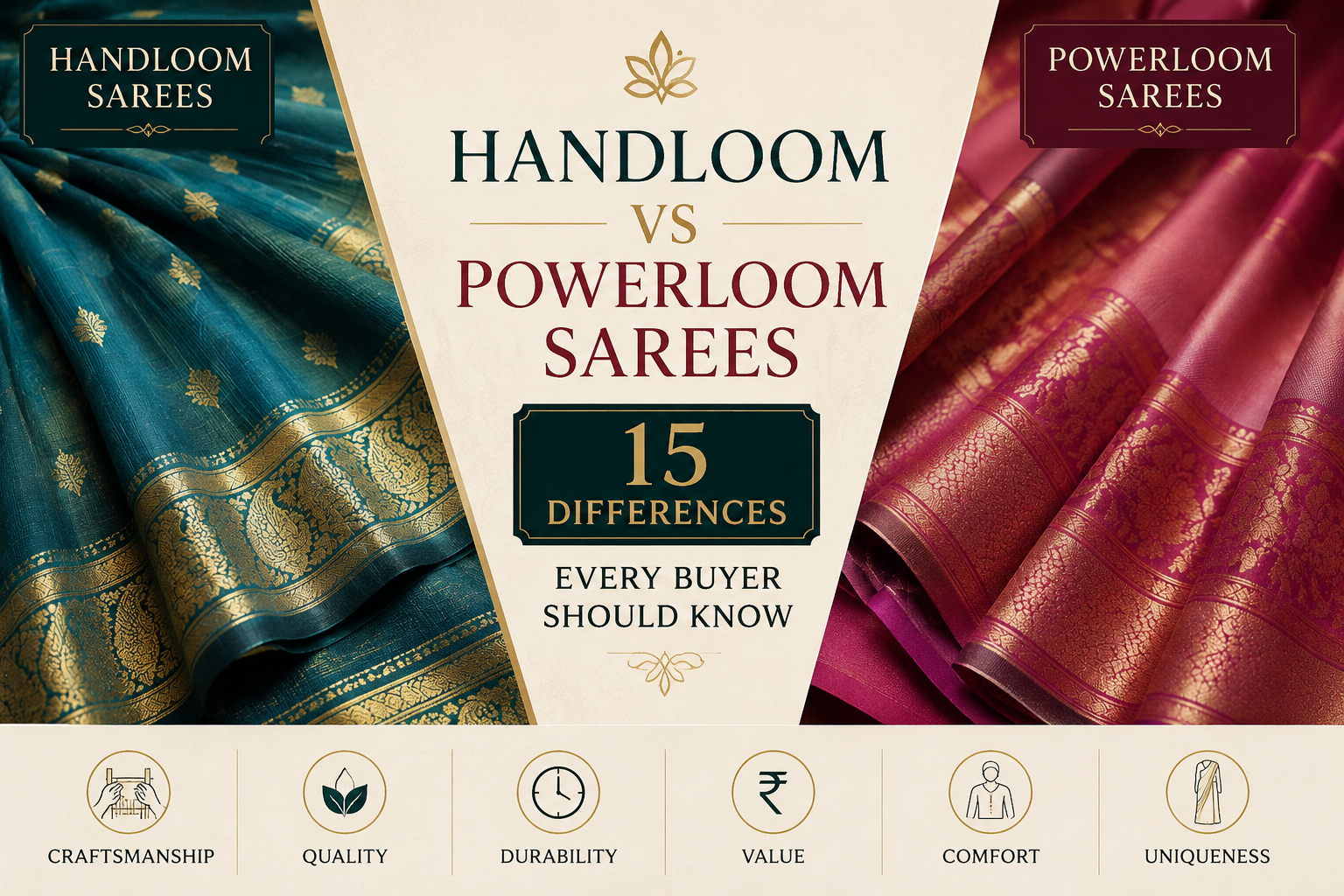
Walk into almost any saree store today and you’ll probably hear the same sentence.
“This is pure handloom.”
The saree looks exquisite. The motifs are intricate. The drape feels luxurious. Unless you’re an experienced collector, there’s every chance you’ll believe it.
Now imagine another saree placed right beside it.
Same colour.
Similar motifs.
Almost identical texture.
One took an artisan nearly three weeks to weave on a traditional loom. The other was produced on a powerloom in less than a day.
Could you tell the difference?
Most people can’t. And that’s hardly surprising. Modern powerlooms have become incredibly sophisticated, producing fabrics that closely resemble traditional handloom weaving. While both handloom and powerloom play important roles in India’s textile industry, confusing one for the other often leads to disappointment, especially when buyers are looking for authentic craftsmanship.
Understanding the difference isn’t about proving that one is superior to the other. It’s about knowing what you’re paying for.
Whether you’re investing in a wedding saree, building a timeless wardrobe or simply becoming a more informed buyer, this guide will help you understand exactly what sets handloom and powerloom sarees apart.
Handloom vs Powerloom: What’s the Difference?
The simplest difference lies in how the fabric is woven.
A handloom saree is woven manually on a traditional loom operated entirely by a skilled artisan. Every pass of the shuttle, every motif and every border depends on human expertise built over years of practice.
A powerloom saree, on the other hand, is woven using electrically operated machines designed for speed, consistency and large-scale production.
The final products may sometimes look similar.
The journey they take to get there is completely different.
That journey affects everything from craftsmanship and individuality to price, sustainability and longevity.
Why Both Handloom and Powerloom Exist
It’s easy to present this as a battle between tradition and technology.
It isn’t.
Powerloom weaving has made sarees more affordable and widely available. It allows manufacturers to meet large-scale demand and produce consistent designs efficiently. For many families, powerloom sarees offer beautiful options within accessible budgets.
Handloom serves a different purpose.
Its value lies in preserving techniques that cannot be replicated by machines. Every saree carries the experience of the artisan weaving it, making each piece subtly unique.
Rather than asking which is better, the more useful question is this:
Which one suits your needs, values and expectations?
If you understand the differences, you’ll never feel misled by marketing or labels again.
15 Differences Between Handloom and Powerloom Sarees
- The Weaving Process
Every handloom saree begins with an artisan sitting at a manually operated loom, carefully interlacing thousands of threads into fabric.
Powerloom weaving relies on mechanised equipment where much of this process is automated.
Both require planning and preparation, but only one depends entirely on human rhythm and skill throughout the weaving process.
- Human Skill vs Machine Precision
Machines are built to repeat.
Artisans are trained to create.
That distinction changes everything.
A handloom weaver constantly adjusts thread tension, alignment and weaving speed while responding to the fabric as it develops. Years of experience allow them to make subtle decisions that machines simply follow as programmed instructions.
This is why authentic handloom weaving is often described as a craft rather than just a manufacturing process.
- Time Taken to Produce a Saree
One of the biggest differences between handloom and powerloom is time.
Depending on the weave and complexity, a handloom saree may take anywhere from several days to several weeks to complete.
Powerloom production dramatically reduces that timeline, allowing similar-looking fabrics to be produced within hours.
Speed isn’t inherently good or bad.
But it does explain why the two products are priced differently.
- Texture and Feel
Ask anyone who regularly wears handloom sarees and they’ll often tell you the same thing.
“A handloom saree feels different.”
Not necessarily softer.
Not necessarily heavier.
Simply different.
Because the fabric is woven manually, it develops a natural texture that changes beautifully over time. It breathes well, drapes gracefully and often becomes even more comfortable with use.
Powerloom fabrics usually feel more uniform because every thread has been placed mechanically with identical tension.
- Uniformity of the Weave
If you’re searching for perfect symmetry, powerloom will usually deliver it.
Every motif.
Every border.
Every repeat.
Almost identical.
Handloom tells a different story.
Tiny variations in spacing or thread alignment are completely natural. These subtle irregularities are often among the strongest indicators that real people, not machines, created the fabric.
They aren’t flaws.
They’re signatures.
- Intricacy of Traditional Motifs
Both handloom and powerloom can produce intricate designs.
The difference lies in how those motifs are created.
On a handloom, the artisan carefully builds each design into the fabric as it is woven.
Powerlooms reproduce designs mechanically, allowing identical motifs to be repeated across thousands of metres of fabric.
For buyers who appreciate exclusivity and craftsmanship, knowing this distinction adds a new layer of appreciation.
- Breathability and Everyday Comfort
Natural fibres play an important role here, but weaving technique also influences comfort.
Many handloom sarees, especially cotton and silk varieties, allow better air circulation because of the way they are woven. This makes them particularly comfortable in India’s climate.
Whether it’s a feather-light Chanderi or a breathable cotton weave, handloom sarees often feel cooler and more comfortable during long hours of wear.
- Durability Over Time
A well-made handloom saree isn’t designed for one season.
It’s designed for generations.
With proper care, authentic handloom sarees often become treasured heirlooms, worn by mothers, daughters and granddaughters alike.
Durability depends on many factors, including the quality of yarn and maintenance, but craftsmanship plays an equally important role.
A thoughtfully woven saree ages gracefully.
It doesn’t simply wear out.
- Price and Value
Price is often the first thing buyers compare, but it rarely tells the complete story.
Powerloom sarees are generally more affordable because machines can produce fabric quickly and in large volumes. This makes them an excellent choice for buyers looking for everyday wear or trend-driven fashion.
Handloom sarees reflect a different kind of value. The price accounts for the artisan’s skill, the time invested in weaving, the use of natural fibres and the limited number of pieces that can be produced. You’re paying for craftsmanship rather than production speed.
That said, authentic handloom doesn’t always have to be prohibitively expensive.
At Woh Chali, we work directly with weaving communities instead of relying on long chains of wholesalers and distributors. This allows us to pay artisans fairly, often 20 to 25 per cent more than they typically receive from bulk buyers, while offering our customers authentic handloom sarees at significantly better prices than many traditional luxury retailers. The savings come from removing unnecessary markups, not from reducing artisan earnings.
- Environmental Impact
One of the biggest advantages of handloom often goes unnoticed.
Traditional handlooms are manually operated and consume very little energy during the weaving process. They also encourage slower production, lower waste and longer product lifecycles.
Powerloom manufacturing depends on electricity and is designed for scale. While it improves efficiency and affordability, it also supports a system where garments are produced and replaced much more quickly.
Neither method should be judged in isolation, but if sustainability is one of your priorities, handloom naturally aligns with the principles of slow fashion.
- Supporting Artisan Livelihoods
Behind every handloom saree is a skilled artisan whose livelihood depends on preserving traditional weaving techniques.
Choosing authentic handloom helps sustain these weaving communities, encourages younger generations to continue the craft and keeps centuries-old traditions alive.
This is one of the reasons Woh Chali exists.
We believe India’s handloom heritage deserves more than admiration. It deserves a business model that values the artisan as much as the finished saree. By sourcing directly from weaving families and commissioning thoughtfully curated collections instead of mass quantities, we create better outcomes for both the weaver and the customer.
- Cultural Heritage
A handloom saree is more than clothing.
It carries the identity of a region, the history of a community and the techniques perfected over generations.
Whether it’s the airy elegance of Chanderi, the regal beauty of Banarasi Katan, the understated sophistication of Maheshwari or the intricate artistry of Jamdani, every weave tells a different story.
Powerloom preserves the visual appeal of many traditional designs.
Handloom preserves the tradition itself.
- Exclusivity
Walk into two different stores and you may find the same powerloom design repeated hundreds or even thousands of times.
Handloom works differently.
Production is naturally limited by the pace of human craftsmanship. Small variations in weaving also ensure that no two sarees are ever completely identical.
This exclusivity is one of the reasons handloom continues to appeal to women who value individuality over mass production.
- Long-Term Investment
Fast fashion encourages us to ask, “How much does it cost?”
Handloom encourages a different question.
“How long will I cherish it?”
A well-maintained handloom saree can remain beautiful for decades. It can accompany you to weddings, festivals, family celebrations and eventually become part of your family’s memories.
Its value grows with time rather than diminishing after a few wears.
- The Buying Experience
Buying a powerloom saree is usually a straightforward purchase.
Buying a handloom saree is often the beginning of a relationship.
You learn where it was woven.
You discover the weaving tradition.
You understand the skill involved.
You begin appreciating the person behind the loom.
That knowledge changes the way you wear the saree.
Handloom vs Powerloom at a Glance
| Feature | Handloom | Powerloom |
| Weaving | Manual | Machine-operated |
| Production Time | Days to weeks | Hours |
| Texture | Naturally varied | Uniform |
| Output | Limited | Large-scale |
| Energy Use | Low | Higher |
| Every Piece Unique | Yes | Mostly identical |
| Artisan Involvement | Complete | Limited during weaving |
| Sustainability | High | Moderate |
| Best For | Heritage, longevity, conscious buying | Affordability, everyday wear, large-scale production |
Which One Should You Choose?
The answer depends entirely on what you’re looking for.
Choose a powerloom saree if affordability, convenience and trend-led fashion are your priorities.
Choose a handloom saree if you value craftsmanship, authenticity, sustainability and clothing that you’ll enjoy wearing for years rather than seasons.
Neither choice is wrong.
The important thing is knowing the difference before making your decision.
Handloom Wisdom
The finest handloom sarees don’t ask for attention through perfection. They earn admiration through the skill, patience and individuality woven into every thread.
Behind the Loom
For generations, India’s weaving families have preserved techniques that cannot be learned overnight or replicated by machines.
Today, many of these traditions face an uncertain future as younger generations move away from weaving in search of more stable incomes.
Every authentic handloom purchase becomes a vote for keeping these crafts alive.
At Woh Chali, we believe customers shouldn’t have to choose between fair prices and fair artisan wages. By working directly with weaving communities, paying artisans respectfully and reducing unnecessary retail markups, we aim to make genuine handloom more accessible while ensuring the people behind the craft receive the recognition and earnings they deserve.
The Woh Chali Perspective
Powerloom has made beautiful sarees accessible to millions, and it continues to play an important role in India’s textile industry.
But handloom represents something machines can never replace.
It represents human ingenuity.
It represents patience.
It represents heritage.
At Woh Chali, we don’t ask people to buy handloom because it’s fashionable. We encourage it because every authentic handloom saree helps preserve a living tradition while bringing exceptional craftsmanship into modern wardrobes. Our collections are intentionally limited, thoughtfully sourced and created to be worn for years, not just for one occasion.
Conclusion
The debate between handloom and powerloom isn’t about declaring one winner.
It’s about understanding two very different approaches to creating fabric.
Powerloom offers efficiency, consistency and accessibility.
Handloom offers craftsmanship, individuality and a direct connection to India’s remarkable textile heritage.
When you understand what goes into every weave, you’re no longer comparing just two sarees.
You’re comparing two philosophies of making, buying and wearing clothing.
The next time you shop for a saree, look beyond the colour and the price tag.
Ask how it was woven.
Ask who made it.
Because once you know the story behind the fabric, choosing the right saree becomes much easier.
Frequently Asked Questions
- What is the main difference between a handloom and a powerloom saree?
The biggest difference lies in the weaving process. Handloom sarees are woven manually by skilled artisans using traditional looms, while powerloom sarees are produced using electrically operated machines. Handloom weaving is slower and results in unique, handcrafted pieces, whereas powerloom weaving focuses on speed, consistency and large-scale production.
- Are handloom sarees better than powerloom sarees?
Neither is universally better. Handloom sarees are ideal for those who value craftsmanship, heritage, sustainability and exclusivity. Powerloom sarees are better suited to buyers seeking affordability, consistency and everyday practicality. The right choice depends on your budget, preferences and the purpose of your purchase.
- Why are handloom sarees usually more expensive?
Authentic handloom sarees require days or even weeks of skilled manual weaving. Their price reflects the artisan’s time, expertise, the use of quality natural fibres and limited production. Unlike machine-made textiles, every handloom saree represents hours of dedicated craftsmanship.
- Which is more sustainable, handloom or powerloom?
Handloom weaving is generally considered more sustainable because manually operated looms consume very little energy and encourage slower, more mindful production. Combined with their durability and timeless appeal, handloom sarees align closely with the principles of slow fashion and conscious consumption.
- How can I identify whether a saree is handloom or powerloom?
Look for subtle variations in the weave, examine the reverse side for woven motifs, ask about the weaving technique and check for certifications such as the Handloom Mark where applicable. Purchasing from transparent brands that openly share information about their artisan partners also helps ensure authenticity.
